
This Timeline of Daion guitars traces the brand’s journey from the modest Japanese luthier Yamaki in the 1950s and ’60s to an internationally respected name in the 1970s and ’80s. With innovative models like the Power and Year Series, Daion earned cult status among musicians and collectors thanks to exceptional craftsmanship and distinctive sound. This timeline highlights key events, designs, and distribution channels that made Daion renowned worldwide.
1954
Many Yamaki acoustic guitars bear the marking “Est 1954” on the headstock, referencing the year Kazuyuki Teradaira, one of Yamaki Guitars’ founders, built his first guitar as a luthier.
1962
Yamaki Guitars is officially founded by Yasuyuki and Kazuyuki Teradaira. Yasuyuki handled accounting and sales, while Kazuyuki led production. Early guitars mainly copied C.F. Martin models (D-18 to D-45) and were sold exclusively in Japan. The factory was originally in Suwa, Nagano Prefecture, moving to nearby Shiga in 1983. “Yamaki” derives from Yama Iku, roughly meaning “happy trees on the mountain.” Over the next two decades, Yamaki produced instruments under its own name and for brands including JooDee, Canyon, Kizan, Folks, Gold Hawk, Tomson, Marchis, Folex, Sonoro, Washburn (early Wing Series), Daion, and others.
1967
Daion Co., Ltd. is founded in Osaka as a musical instrument wholesaler and becomes the exclusive Japanese distributor of Yamaki Guitars. Daion appears on numerous early Yamaki brochures and catalogs from the 1970s. Around this time, Daion is also distributing Shinano guitars. By the late 1970s and early 1980s, Daion distributes U.S. brands in Japan, including Peavey, Washburn, and Mighty Mite.
1974
Hirotsugu (Hiro) Teradaira, son of Yasuyuki, graduates from Kwansei Gakuin University and joins Daion Co., Ltd. Meloway, Inc. in Minneapolis prints a brochure featuring Yamaki models, likely among the first U.S. distributors of Yamaki guitars
1975-1977
Hiro works for Great West Imports Ltd. in Vancouver, Canada, learning the North American market. Shinano, a Yamaki subsidiary, produces classical guitars while Yamaki focuses on steel-string acoustics. Yamaki and JooDee guitars for Canada carry the “AY” model prefix. Hiro returns to Japan in 1977 to help establish Daion’s trading division.
1976–1977
JooDee and Yamaki feature similar slogans in advertising: JooDee “Get In Rock” and Yamaki “Get in Folk.” Occasionally, both brands appear together. Kizan appears briefly as a Yamaki brand, a Japanese wordplay on Yamaki. Yamaki collaborates with Waltz-Do for two exclusive acoustic models featuring a visible aluminum neck strip.
1978
Hiro Teradaira designs his first guitar, marking the start of the iconic YEAR SERIES with THE ’78, followed by ’79, ’80, ’81, and ’82. A Yamaki catalog lists electric guitars, including the new Performer models with innovations like the Epochal Rod System (ERS) on Fender-style guitars and shielded PCB
1978–1984
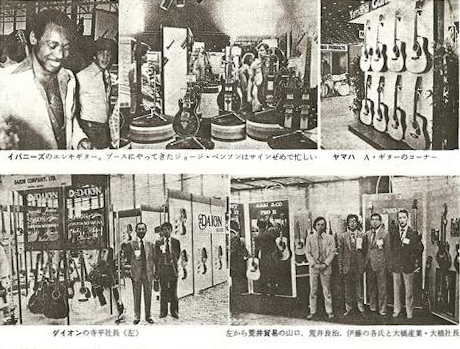
Daion guitars are exported internationally, managed by Hiro Teradaira. The “Yamaki” name is avoided in the U.S. to prevent confusion with Yamaha. Eleven countries distributed Daion instruments. Daion participates in the NAMM Show in Chicago representing multiple brands. In the U.S., MCI, Inc. of Waco, Texas, becomes Daion’s exclusive distributor, advertising the brand from 1979.
1979–1984
Daion launches the POWER SERIES electric guitars and basses. First-generation models (1979–1980) combine elements of the Washburn Wings Series, while the second generation (1980–1984) is sold exclusively under the Daion name.
1981–1983
Full catalogs include the Power Series and Savage Series, along with models like the HEADHUNTER 555. Yamaki ceases Daion production by 1983, possibly transitioning to Cushin until 1984.
1984
The final MCI catalog features Daion instruments, including the Power X-BD double-neck bass. The Mark IV is absent, and green is no longer an option for the POWER MARK series. THE ’84 Pro, Hiro Teradaira’s final design, remains a prototype.
Closure in Japan
Daion Co., Ltd. ceases all Japanese production due to financial constraints. Hiro Teradaira recalls the challenges: meeting demand for 3,000 guitars monthly was impossible with limited wood supplies, causing significant production issues.
1984–1985 – Brazos Era
After Daion’s closure, the Brazos brand emerges, including the BA-78 model based on THE ’78, assembled in Korea.
1984–1985 – Anea Project
John Birkhead launches Anea, producing guitars in Japan and Korea using Daion designs. Notable models: SE-15 (THE ’78), EO-9/T (’81 Caribou), TN-27 (Legacy 999).
1985 – Hiro Teradaira’s New Path
Hiro becomes a radio DJ at FM802 in Osaka, gaining popularity and respect over decades.
1985–1987 – Daion in Australia
CMI (Central Musical Instruments) continues selling remaining Daion components, assembling new Performer models in Korea. The brand gradually phases out Japan-made models, replaced by Korea-made Rockson versions.
1991 – Final Trace
The last known publication selling Daion instruments dates from 1991. After this, the Daion name disappears commercially but lives on among collectors, players, and enthusiasts who remember its distinctive tone.
Notable Musicians
Artists regularly playing Daion instruments include:
Brad Whitford (Aerosmith) – Daion Year – The ’80
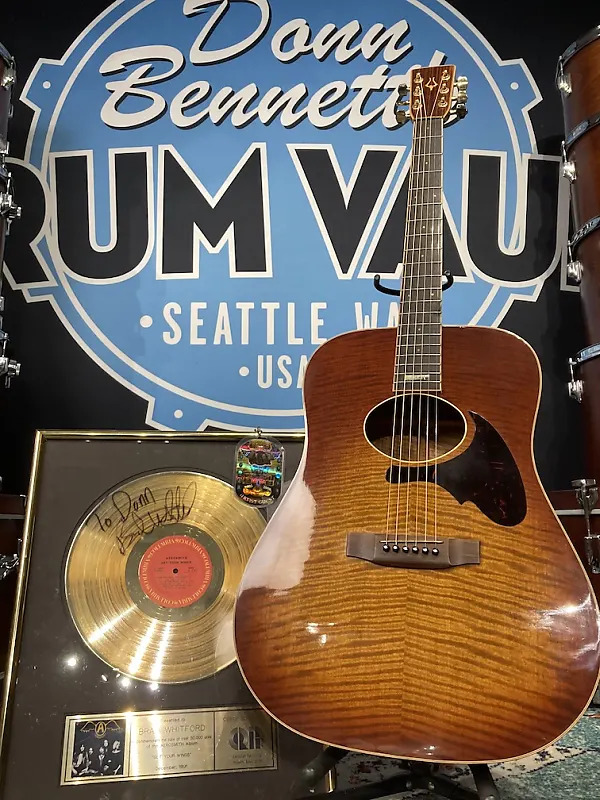
Lasse Tennander – Daion Caribou
Jahn Teigen Daion Caribou/Gazelle blauw
Split Enz – Daion Savage Gitaar en Bas
Ray Fenwick – Daion Performer YST Serie

Tom Hamilton (Aerosmith) – Daion Year – The ’80
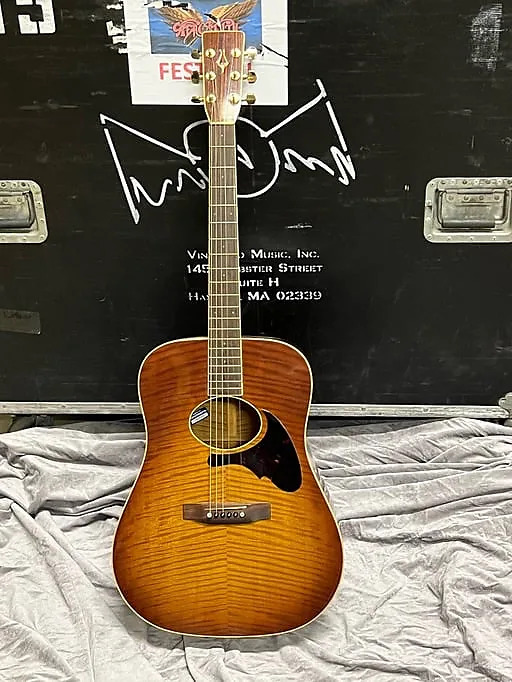
Warren Haynes (Allman Brothers, Gov’t Mule) – Dion Powermark XX
Interviews
TalkBass.com – Interview met Mr. Hirotsugu Teradaira – Geplaatst: 25 Januari 2019
The Sakai News – Interview met Mr. Hirotsugu Teradaira – Gepubliceerd: 3 April 2023
The Sakai News – Interview met Mr. Hirotsugu Teradaira – Gepubliceerd: 4 April 2023
The Sakai News – Interview met Mr. Hirotsugu Teradaira – Gepubliceerd: 6 April 2023